Singing Monsters: Dawn of Fire
- 4.8
- Rating
- 10.00M
- Installs
- Free
- Price

 Analysis by App-foxy
I went into Singing Monsters: Dawn of Fire expecting a light music game, but it quickly showed me that its appeal is broader than simply tapping along to songs. It is a free game in the music category from Big Blue Bubble Inc., built around collecting unusual monsters, developing their world, and hearing how their individual performances fit together. The central question is not whether it has a large amount of content; it is whether you enjoy slowly shaping a playful musical collection and checking in on it over time.
That distinction matters when choosing between this and a traditional rhythm game. If you want immediate reflex challenges, fixed levels, and a clear score at the end of every track, this may feel indirect. If you like nurturing a collection, making gradual decisions, and watching a soundscape become richer as you play, it has a much stronger case. I found the experience most enjoyable when I treated it as a relaxed routine rather than a game I had to rush through.
What to consider before choosing it
The first decision is about the kind of music interaction you want. This is not primarily a song library with familiar artists or a timing test based on tapping notes. Its musical identity comes from the monsters themselves. Each one contributes to the atmosphere, and the satisfaction comes from arranging progress so that the world sounds increasingly complete.
You May Also Like

 Google Keep - Notes and lists
Google Keep’s Quiet Growth Shows the Appeal of Simpler Notes
As mobile work gets busier, Google Keep keeps winning a simple contest: capture a thought quickly, find it later, and get on with the day.

 Blood Strike: 2.5 Anniversary
Blood Strike’s Loadouts Turn Every Drop Into a Tactical Gamble
A close look at Blood Strike’s custom loadouts: how fast access to signature weapons reshapes its battle royale rhythm, rewards preparation, and narrows the gap between fights.

 Pandora - Music & Podcasts
Pandora’s Music Is Easy to Start, but Harder to Recover
Pandora’s strength is its low-effort path from a seed to a station. Its weak spot is how much confidence it asks you to place in connection, setup, and quiet recovery.

 8 Ball Pool
 Is Built on Rivalries, Rematches, and Routine
A close look at the rivalries, rematches, shared routines, and unanswered safety questions that turn a quick pool match into a persistent mobile community.

 Samsung Music
’s Quiet Strength Is Playing What You Already Own
Its reach comes less from spectacle than from dependable access to a personal library. That simplicity is both the app’s strongest retention engine and its ceiling.

 AccuWeather: Weather Radar
AccuWeather Review: A Quick, Clear Forecast for Everyday Decisions
For everyday plans, the best forecast is the one you can understand quickly. AccuWeather makes rain timing, radar, and local conditions easy to act on, with a few trade-offs.
More From Our News Desk



That makes the game a good fit for players who enjoy collection and world-building alongside music. I could open it for a short visit, check what needed attention, make a small upgrade or collection decision, and leave without feeling that I had failed by not committing to a long session. The slower rhythm is part of its charm, although it can also be the main source of frustration for anyone who prefers constant action.
The second decision is how comfortable you are with a free-to-play structure. The download costs nothing, and optional purchases range from $0.99 to $99.99 per item. That wide range is worth noticing before installing, especially if the game is intended for a younger player. The content rating is Everyone, but an age-friendly presentation does not automatically mean every purchase decision will be simple for a child.
I would set expectations early: progress is designed to feel gradual, and spending can change how quickly you move through it. I did not see the game as something that needs purchases to be enjoyable, but players who dislike waiting, resource management, or repeated check-ins may feel pressure sooner than players who are happy to let progress unfold naturally.
Device compatibility is also straightforward. The listed minimum is Android 7.0, while the current version is 4.0.5. On a suitable device, the colorful presentation and layered audio are the parts that deserve attention. I would still keep the operating system requirement in mind when recommending it for an older phone or tablet, because music-heavy games are less pleasant when the device struggles with loading or sound.
How the musical loop actually feels
The most rewarding loop is built around making choices that improve the overall ensemble rather than chasing one isolated reward. A monster is not merely another item in a collection; it changes the way the world feels when it joins the others. I enjoyed listening for the difference between a sparse arrangement and a fuller one, especially because the result gives progress a sound instead of presenting it only through menus or numbers.
One useful habit is to listen before making a decision about what to develop next. It is tempting to focus only on the most visually appealing creature, but the better choice may be the one that fills a missing musical role. This turns collection into a small arrangement puzzle: I began asking which addition would make the whole group feel more balanced, rather than which monster I personally liked best.
Another practical tip is to treat short visits as part of the design. I found the game easier to enjoy when I checked it during natural pauses, such as after finishing a study break or while waiting for an appointment. That approach avoids turning every return into a demand for a long session. It also helps with the slower pace, because small improvements feel more satisfying when they are not judged against a game built for nonstop play.
The audio is not just decoration. It gives me a reason to revisit areas that might otherwise feel like routine management screens. Before committing to the game, however, consider whether you normally play with sound on. If your phone is usually muted, a major part of the experience becomes less noticeable, and the game may seem more like a standard collection title than a music-focused one.
Where this game stands out
Its strongest feature is the way progression and music support each other. Many collection games make the collection itself the destination, while many rhythm games make performance the destination. Here, the monsters are both the things I collect and the performers that make the setting feel alive. That combination gives each addition more personality than a simple inventory entry.
I also like that the tone remains approachable. The unusual creatures and bright presentation make it easy to understand what kind of world I am entering without requiring a serious musical background. You do not need to know how to read music or recognize technical composition terms to appreciate the result. The game communicates through sound, animation, and gradual visual changes, which makes it accessible for casual players.
For families, that accessibility can be useful, but I would still play alongside a child at first. The best conversation is not about winning; it is about asking which monster sounds different, why one addition changes the group, and whether a purchase is actually needed. That turns the game into a gentle introduction to arrangement and listening while also keeping the free-to-play side visible.
A less obvious strength is that the game gives sound-based feedback to decisions that might otherwise feel abstract. When I choose a development path and later hear a fuller musical result, the payoff is easier to understand than a generic progress bar. This makes it particularly suitable for players who lose interest in games where upgrades are only statistical.
The game also works well as a low-pressure creative break. I would not describe it as a music-making tool in the same way as a dedicated composition app, because the player is working within the game’s own world and systems. Still, it encourages attention to texture, repetition, and how separate parts combine. That is a meaningful difference from simply collecting characters for visual completion.
Everyday use and the limits of short sessions
Imagine having ten minutes before leaving for work or school. You can open the game, review the current state of your world, make a sensible collection or development choice, listen to the updated ensemble, and close it again. In that situation, the game feels comfortable because it does not require the same concentration as a competitive rhythm challenge. It gives the break a sense of continuity without asking you to finish a full stage.
That same scenario reveals a limitation. If you want a complete, self-contained musical challenge in those ten minutes, this may not satisfy you. The most interesting results often depend on gradual development, so a single visit may feel like one step in a longer process. I enjoyed that continuity, but someone looking for instant closure may prefer a conventional rhythm game with short, clearly finished rounds.
Another trade-off is attention. A game built around returning to a growing world can become part of your routine, which is pleasant when you control the routine and less pleasant when you feel obliged to check constantly. I recommend deciding in advance how often you want to play. That simple boundary keeps the game relaxing and prevents the collection loop from becoming a chore.
It is also worth using headphones when practical. The layered performances are easier to appreciate when individual sounds do not blend together with traffic, television, or conversation. I would not make headphones mandatory, but they help reveal why the musical side is more than background noise.
Where other types of games may fit better
A dedicated rhythm game is the better choice if your priority is precision. Those games usually make timing, reaction speed, and personal performance the center of attention. In comparison, this title asks me to care more about the ensemble and the gradual state of the world. It can feel less exciting if I am in the mood to test my reflexes every few seconds.
A conventional creature-collection game may suit you better if your main goal is battles, competitive strategy, or a large roster whose value is measured through direct encounters. The monsters here are most compelling as members of a musical environment. If you want tactical combat first and personality second, the difference will be obvious.
A dedicated music-making app is another alternative for users who want to compose freely, record ideas, or control individual notes and instruments. This game offers a guided creative experience rather than an open studio. I prefer it when I want the motivation of collecting and unlocking a world, but I would choose a composition tool for serious songwriting or detailed control.
Even a purely decorative collection game could be a better match for someone who dislikes audio-led progress. In this title, listening is central to understanding why your choices matter. If you normally play without sound and have no interest in turning it on, the visual collection may not carry the whole experience for you.
Spending, patience, and the cost of changing direction
The free entry point is a real advantage. I could try the core idea without paying first, which makes it easier to decide whether the musical collection loop suits me. The important cost is not the download; it is the possibility of spending to reduce friction or speed up progress. Because individual purchases can reach $99.99, I would enable purchase safeguards before handing the device to a child.
My advice is to play long enough to understand the normal pace before buying anything. That gives you a reference point. If you later decide that an optional purchase improves your enjoyment, it becomes a deliberate choice rather than a reaction to early impatience. I would also avoid spending simply because a single session feels slow; the game is designed around gradual development, and paying does not change whether you actually enjoy that style.
There is a switching cost when moving from this to another category. If you leave for a fast rhythm game, you gain immediate challenge but lose the continuity of a world that develops between sessions. If you move to a free-form music app, you gain control but lose the collection structure that gives casual play a clear direction. If you move to a battle-focused creature game, you gain competition but give up the ensemble as the main reward.
That is why I would not compare this only by graphics or download price. The real choice is between different kinds of engagement: listening and arranging, reacting to timing, composing directly, or competing through strategy. Once I identified that difference, it became much easier to decide whether returning to the game felt rewarding or merely habitual.
Who should install it
I recommend it to players who like music-driven collection games, friendly fantasy worlds, and progress that can be enjoyed in small visits. It is especially appealing if you like hearing a world become more complete as you make thoughtful additions. The Everyone rating and simple presentation make it approachable, while the free price makes experimentation easy.
I would also recommend it to parents who want to explore a game with a child rather than hand over a competitive experience without discussion. Listening together can make the monsters more meaningful, and talking about optional purchases creates a useful boundary. I would not present it as an educational music course, but it can encourage curiosity about rhythm, layering, and musical contrast.
I would skip it if your ideal music game is built around licensed songs, leaderboards, perfect timing, or rapid rounds. I would also skip it if you dislike waiting for gradual progress or feel uncomfortable with optional purchases in free games. Those are not small details; they affect the basic rhythm of play.
For me, the deciding strength is the way the collection has an audible purpose. I am not only gathering creatures because the game tells me to; I am building a cast whose presence changes the sound of the world. That gives the long-term loop more character than a standard checklist, even when the pace slows down.
With a 4.7 average from around 199 thousand ratings and more than 10 million installs, it is clearly a well-established choice in its space. Those figures do not replace personal taste, but they do match my impression that the concept has broad appeal. The developer, Big Blue Bubble Inc., has created something that is easy to start yet specific enough to divide players by preference: some will love the patient musical development, while others will want more direct action.
My final recommendation is to try it as a relaxed, sound-on game rather than expecting a conventional rhythm challenge. Give the ensemble time to develop, listen to the effect of your choices, and decide on spending limits before you begin. If that combination of monsters, music, and gradual collection sounds enjoyable, Singing Monsters: Dawn of Fire is a charming free option. If you need immediate precision or unrestricted composition, choose a different kind of music game instead.
FAQs for Singing Monsters: Dawn of Fire
01What is the main objective of Singing Monsters: Dawn of Fire?
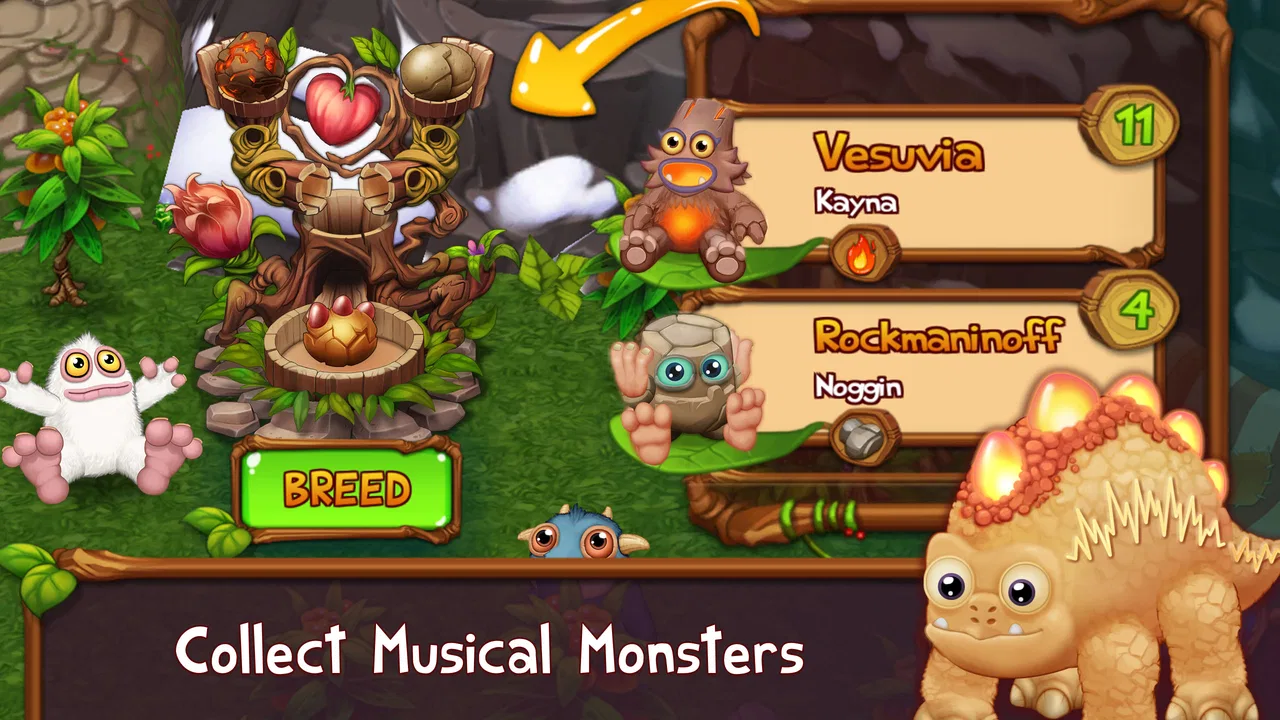
Singing Monsters: Dawn of Fire is a prequel to the popular My Singing Monsters game. The main objective is to collect and breed adorable monsters, each with its unique musical talent, to create a symphonic world. Players can expand their islands, manage resources, and enjoy the evolving melodies as they progress.
02Is Singing Monsters: Dawn of Fire free to play?
Yes, Singing Monsters: Dawn of Fire is free to download and play on both Android and iOS devices. However, it includes in-app purchases for various items and currency, which can enhance gameplay. These purchases are entirely optional, allowing players to enjoy the game without spending real money.
03What are the system requirements for Singing Monsters: Dawn of Fire?
Singing Monsters: Dawn of Fire requires a device running Android 4.1 or higher, or iOS 9.0 or later. It’s compatible with most modern smartphones and tablets. Ensure you have sufficient storage space and a stable internet connection for the best gaming experience and to access all features.
04How does breeding monsters work in Singing Monsters: Dawn of Fire?
In Singing Monsters: Dawn of Fire, you can breed monsters by selecting two compatible monsters from your collection. The breeding process can result in new, unique monsters with different musical abilities. Experiment with various combinations to discover all possible monster types and expand your musical ensemble.
05Are there any tips for beginners in Singing Monsters: Dawn of Fire?
For beginners, it’s important to focus on building your resources and expanding your islands early on. Regularly collect coins and food, and complete quests to level up. Also, experiment with different monster combinations to unlock new species and enhance your musical world. Patience and strategic planning are key.
Pros
- Engaging gameplay with unique monster characters.
- Stunning graphics and vibrant animations.
- Regular updates with new content and features.
- Simple controls suitable for all ages.
- Creative soundtracks add to the fun.
Cons
- In-app purchases can be pricey.
- Requires constant internet connection.
- Game progress can be slow without purchases.
- Limited offline play options.
- Some users report occasional bugs.

Singing Monsters: Dawn of Fire
Gallery